|
|
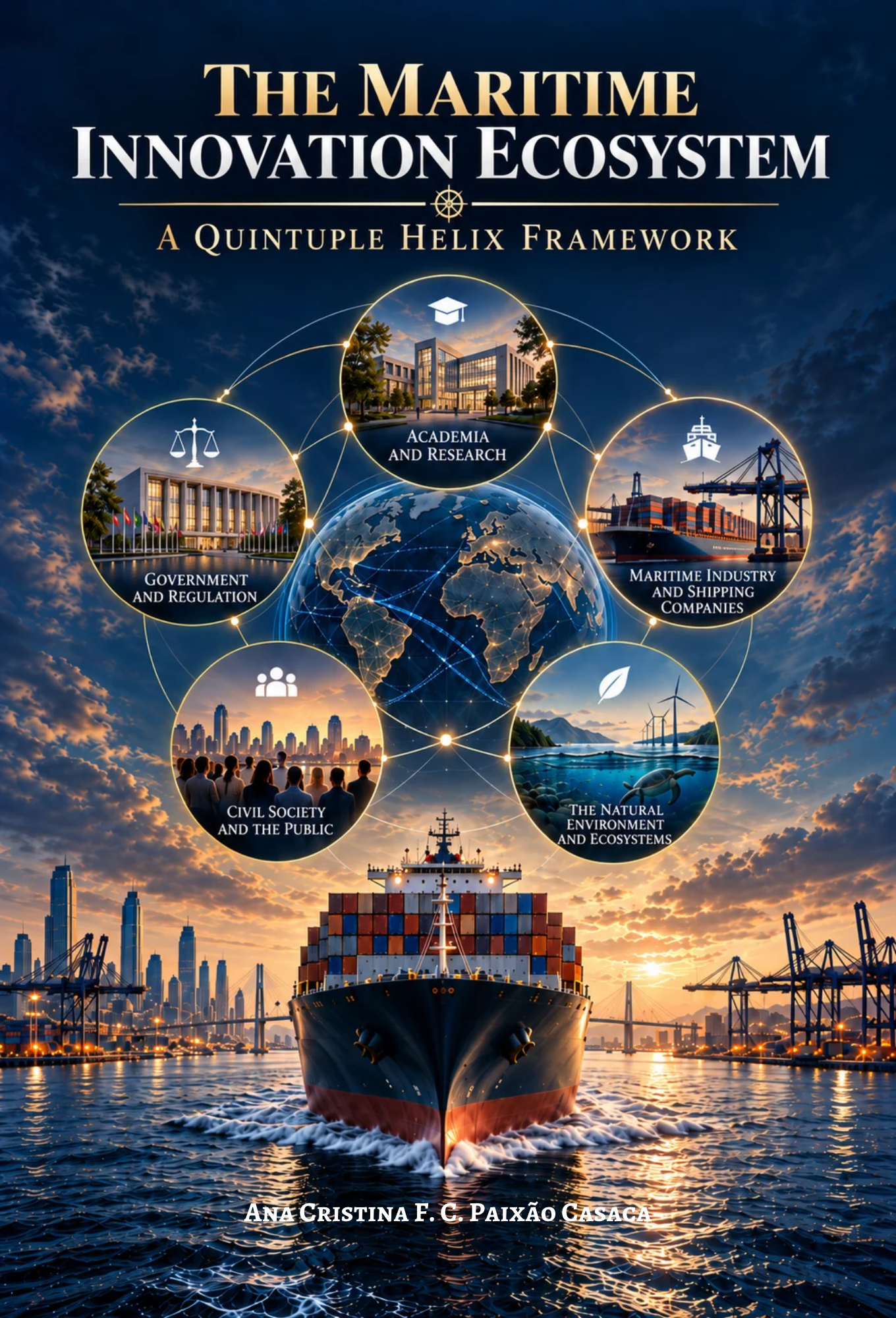
| THE MARITIME INNOVATION ECOSYSTEM. A QUINTUPLE HELIX FRAMEWORK |
| |
| |
| Ana Cristina Ferreira Castela Paixão Casaca, World of Shipping Portugal, Parede, Portugal. |
 https://orcid.org/0000-0003-3925-473X |
| |
| |
| |
| SUMMARY |
| This work develops the Shipping-Centred Quintuple Helix Framework as an analytical and governance framework for understanding collaborative innovation and transformation in maritime transport. It combines ecosystem theory with the innovation ecosystem perspective and adapts the established Quintuple Helix model to the specific organisational, technological, regulatory, societal and environmental characteristics of maritime transport. The resulting framework distinguishes five interacting domains: academia and research; government and regulation; the maritime industry ecosystem; civil society and the public; and the natural environment and ecosystems. These helices are analytically distinct but permeable, and their relative importance may vary depending on the innovation, stage of development, and implementation context under examination. |
| Within the maritime industry helix, shipping companies are positioned as focal integrators because their commercial and operational activities connect ships, cargo interests, ports, terminals, shipyards, equipment manufacturers, fuel and energy suppliers, financial institutions, insurers, digital and technology providers, classification societies, regulators and knowledge institutions across international supply chains. Their role is coordinative rather than hierarchical. Shipping companies are not a sixth helix, do not exercise unilateral control over the ecosystem and need not lead every innovation process. Authority and influence are distributed, while orchestration may shift among ports, energy suppliers, cargo coalitions, technology providers, shipyards, or other participants depending on the innovation and its stage of development. |
| The framework applies to maritime transformation associated with decarbonisation, digitalisation, and automation, along with their implications for resilience. It demonstrates that technological feasibility alone is insufficient for successful implementation. Innovation also depends on aligning complementary knowledge, infrastructure, regulation, finance, skills, market demand, standards, contractual arrangements, and organisational capabilities. It further depends on the compatibility and sequencing of investments across organisations whose incentives, decision rights, risk tolerance and time horizons may differ. Particular emphasis is therefore placed on interdependence, coordination, interoperability, regulatory learning, operational learning and the circulation of knowledge across organisational and institutional boundaries. |
| Innovation is understood as a multidirectional and iterative process rather than a linear transfer from research to industry. Knowledge, policy signals, market requirements, resources and environmental evidence circulate among the five helices and are interpreted, combined and transformed through interaction. Cross-cutting capabilities, including digitalisation and data, technological capability, human capital and skills, finance and investment, cybersecurity, and international collaboration, support these exchanges and influence the system's capacity to move from experimentation and demonstration to adoption, implementation, and routine operation. Civil-society participation introduces experiential knowledge, legitimacy, fairness and accountability. At the same time, the natural environment occupies a distinct position as the ecological context that provides resources, imposes limits, generates pressures and receives the consequences of maritime activity. |
| Rather than proposing a deterministic causal model, the Shipping-Centred Quintuple Helix Framework provides a structured heuristic for identifying actors, functions, interdependencies, coordination gaps, trade-offs, responsibilities and opportunities for co-created innovation. It supports the analysis of how maritime innovations are developed, financed, regulated, tested, implemented, evaluated and adapted, while recognising that the composition and influence of the helices are context-dependent. In this way, the framework provides a systemic basis for examining how technological, organisational, institutional, societal and environmental dimensions interact to shape sustainable, resilient and technologically advanced maritime transport. |
| |
| KEYWORDS |
| Maritime innovation ecosystem; Quintuple Helix; Shipping companies; Maritime transport; Decarbonisation; Digitalisation; Automation; Resilience; Collaborative innovation; Sustainable maritime transformation. |
| |
| |
| |
|
| |
| |
| |
ANNUAL SUBSCRIPTION |
| |
| Gain access to the WofSPortugal Knowledge Hub, a specialist digital library containing original texts on maritime transport, shipping, logistics and related fields. The content draws on my academic publications, research, teaching and extensive professional experience in the maritime sector. Subscribers will also have access to carefully selected links to complementary resources, including case studies, technical references, recommended readings, institutional publications and reliable sources of updated specialist information. |
| |
| Please note that the publication entitled Maritime Logistics. A New Curricular Unit and the Workshops are excluded from the WofSPortugal Knowledge Hub Annual Subscription and is subject to separate access conditions. |
| |
ANNUAL SUBSCRIPTION FEES |
| |
| Individual Student Subscription: €250 per year, plus VAT (Total Payable: €307.50). |
| Individual Professional Subscription: €600 per year, plus VAT (Total Payable: €738). |
| Company Subscription: €900 per user per year, plus VAT where applicable (Total Payable per User per Year: €1,107 VAT included). |
| University, Educational or Training Institutions: Quotation upon request, plus VAT where applicable. |
| Where VAT applies, Portuguese VAT will be charged at the current standard rate of 23%. Whether VAT is chargeable will depend on the subscriber’s tax status. |
| |
ACCESS AND USE |
| |
| All original materials are available exclusively for consultation through the WoSPortugal Knowledge Hub and cannot be downloaded, reproduced, printed, recorded, shared, distributed or republished without prior written authorisation. |
| Access credentials are personal and non-transferable. A subscription grants access to the WoSPortugal Knowledge Hub but does not transfer ownership or intellectual property rights to the subscriber. |
| Links to complementary external resources are provided for study and research purposes. Their content remains subject to the availability and terms established by the respective authors, publishers and organisations. |
| Each subscription is valid for 12 months from the date of activation. |
| |
SUBSCRIPTION ENQUIRIES |
| |
| Subscriptions will be available from January 2027. |
| To subscribe, please send an email to training@worldofshipping.org or fill in the form below, indicating the required subscription category. Students should prepare a valid proof of enrolment and deliver it upon request. Companies, universities and academic institutions should also specify the expected number and type of users so that an appropriate quotation can be prepared. |
| |
| |
| |
| COMPLETE YOUR SUBSCRIPTION |
| |
|
| |
| Top of the page |
| |
|
|