|
|
| Editorials and Research Contributions |
| |
| |
Editorials |
| |
| Paixão Casaca, A. C. and Loja, M. A. R. (2023). 2022 World of Shipping Portugal: An International Research Conference on Maritime Affairs Editorial “Maritime Economics in the Post-Covid-19 Pandemic”. Journal of Shipping and Trade. 8, Article ID: 13. https://doi.org/10.1186/s41072-023-00143-y. |
| Abstract: The COVID-19 pandemic has changed the world. It showed the possibility of running economic activities remotely, allowing people to learn how to have a more balanced life. As a result, electronic commerce flourished, and it is here to stay. However, only time will tell whether people will shop more online or return to traditional brick-and-mortar shopping. With more people at home, prevented from going out to a cinema, or a theatre, the service industry was severely impacted until governments relieved the confinement measures so that their economies returned to pre-pandemic levels. Certainly that container shipping was the winner of all shipping market segments, given the increased number of finished goods to be carried. When all seemed to return to normalcy, the Russian–Ukraine crisis complicated the economic and political environment. Maritime transport was affected in the Black Sea, and only after many weeks of negotiation did the parties involved reach the Ukraine grain deal enabling Ukraine to transport millions of tonnes of food through the Black Sea despite the ongoing conflict. The number of sanctions against Russia increased, and many countries and regions were forced to look for alternative sources of oil, oil by-products and gas, this time benefiting the gas and tanker shipping markets with increasing freight rates. Apart from this, the maritime industry is still facing extraordinary challenges. Endeavours are being made to accelerate industry decarbonisation, digitalisation and operations optimisation. The quest for finding alternative fuels to power the world fleet is there. For now, LNG and methanol are the most promising alternatives, with the possible installation of carbon storage units to mitigate carbon dioxide emissions into the atmosphere. These events draw the industry to deal with the market, technology, and regulatory challenges and risks whose outcome is yet to be seen. With this background, seven papers presented at the 2022 World of Shipping Portugal Conference, An International Research Conference on Maritime Affairs, 27–28 January, that took place online via CiscoWebex due to the Covid-19 pandemic were selected to be published in this Special Issue. They open the scope for new research areas and address essential aspects that contribute to the efficiency of the overall maritime sector. |
| |
| Paixão Casaca, A. C. and Lyridis, D. V. (2022). Guest Editorial: Port Business and Green Innovation. Maritime Business Review, 7(1), pp.2-4. https://doi.org/10.1108/MABR-03-2022-077.
|
| This special issue gathers selected papers of the 2021 World of Shipping Portugal, An International Research Conference on Maritime Affairs, taking place online, on 28–29 January 2021. Subject to the theme “Port Business and Green Innovation”, this special issue consists of topics in pilotage and autonomous shipping, corporate social responsibility and social media, blockchain and business process modelling, port governance models and regulatory frameworks. We would like to thank all authors for contributing to this special issue. |
| |
| Paixão Casaca, A. C. and Loja, M. A. R. (2021). 2021 World of Shipping Portugal: An International Research Conference on Maritime Affairs Editorial “In the Aftermath of 2020! What’s Next?”. Journal of Shipping and Trade. 6, Article ID: 16. https://doi.org/10.1186/s41072-021-00099-x. |
| Abstract: Currently, the shipping industry is at a crossroads. Although it has overcome numerous technological barriers and finance and economic crises over the years, the industry is facing its most prominent challenge, which rests on finding the most feasible solutions to deal with industry decarbonisation until 2050. Within this scope, the current Editorial addresses the issue of sulphur emissions that the industry faced with the entrance of the sulphur regulation on 1 January 2020 and draws attention to the road that the industry players need to cover to decarbonise the shipping industry. Innovative measures like the Poseidon Principles or the Sea Cargo Charter are in place, and industry players are coming together to find feasible solutions. Within this regulatory environment, the shipping industry also had to deal with the COVID-19 Pandemic. However, some market segments, such as the container and dry bulk ones, have managed to survive, which is not the case with the tanker market. Altogether, these events draw the industry to deal with the market, technology, and regulatory challenges and risks whose outcome is yet to be seen. The Editorial concludes by presenting briefly the papers published in this Special Issue, which were selected among the ones presented at the 2021 World of Shipping Portugal, an international research conference on maritime affairs, 28–29 January 2021, that took place online from Portugal to the World due to the Covid-19 pandemic. |
| |
| Paixão Casaca, A. C. and Loja, M. A. R. (2020). 2019 World of Shipping Portugal. An International Research Conference on Maritime Affairs Editorial “Leading the Shipping Industry into the Future". Journal of Shipping and Trade, 5, Article ID: 27. https://doi.org/10.1186/s41072-020-00082-y. |
| Abstract: The current Editorial addresses the evolutionary path of the shipping industry. It mentions its role throughout the years, identifies the leading market segments, refers to the different operational modes due to the inherent nature of the cargoes they carry and lists some trends that appear to have been shaping the maritime industry. Within the scope of this background, the Editorial claims that all maritime market segments face the same future challenges and lists a range of international legislation released by the International Maritime Organisation which industry players must comply with. The Editorial concludes by stating that the maritime industry will benefit from the implementation of innovative solutions and further claims that wrong decisions will have severe impacts on the finances of the shipping companies and the environment. Moreover, it presents in a brief way the papers published in this Special Issue, which were selected among the ones presented at the 2019 World of Shipping Portugal, an International Research Conference on Maritime Affairs, 21–22 November 2019, that took place at Hotel Riviera, in Carcavelos, Portugal. |
| |
| Paixão Casaca, A. C., Yip, T. L., Lee, P. T-W, Goulielmos, A. M. (2017). Editorial: Short Sea Shipping in a Globalised World, International Journal of Shipping and Transport Logistics, 9(3), pp.257-260. |
| |
| Paixão Casaca, A. C., Duarte, L. F., Lun, Y. H. V. (2011). Editorial: Shipping and Transport Logistics in a Changing Economy, International Journal of Shipping and Transport Logistics, 3(4), pp.345-348. |
| |
| Top of the page |
|
| |
Book Chapters |
| |
| 2026 - Co-written with Cassia Bommer Galvão and Ana Rita Lynce. Smart Contracts in Maritime Transport. In: Joseph Sarkis (Edt.), The Palgrave Handbook of Blockchain Technology for Business, pp.1–59. DOI: 10.1007/978-3-031-76014-3_58-1 |
| |
| 2026 - Co-written with Cassia Bommer Galvão and Ana Rita Lynce. Smart Contracts. In: Joseph Sarkis (Edt.), The Palgrave Handbook of Blockchain Technology for Business, pp.1–36. DOI: 10.1007/978-3-031-76014-3_45-1 |
| |
|
| |
| 2026 - Co-written with Enrico Musso and Ana Rita Lynce. Chapter 11. Economics of Shortsea Shipping. In: Costas Th Grammenos (Edt.), The Handbook of Maritime Economics and Business, 3rd ed., pp. 311-370. DOI: 10.4324/9780429261664-15 |
| |
| 2014 - Chapter 12. European Short Sea Shipping Policy Issues. In: Jingjing Xu (Edt.), Contemporary Marine and Maritime Policy, Nova Science: New York, pp. 229-269. |
| |
| 2013 - Chapter 9. Port choice in the European short sea shipping market: a port authorities view point. In: Ennio Forte (Edt.), Economics and Logistics in Short and Deep Sea Market. Studies in honor of Guido Grimaldi Founder of Grimaldi Group, FrancoAngeli: Milano, pp. 198-227. |
| |
| 2010 - Co-written with Enrico Musso and Ana Rita Lynce. Chapter 13. Economics of Shortsea Shipping. In: Costas Th Grammenos (Edt.), The Handbook of Maritime Economics and Business, 2nd ed., Lloyds of London Press: London. pp. 391-429. |
| |
|
| |
| Top of the page |
|
| |
Book Reviews |
| |
| |
| Paixão Casaca, A. C. (2014). Book Review: Peter Hall, Robert J. Mccalla, Claude Comtois, Brian Slack (EDT). Integrating Seaports and Trade Corridors, Ashgate, Surrey, 2011 (First edition), The Asian Journal of Shipping and Logistics, 30(1), pp.117-120. |
| |
| Top of the page |
|
| |
Other Research |
| |
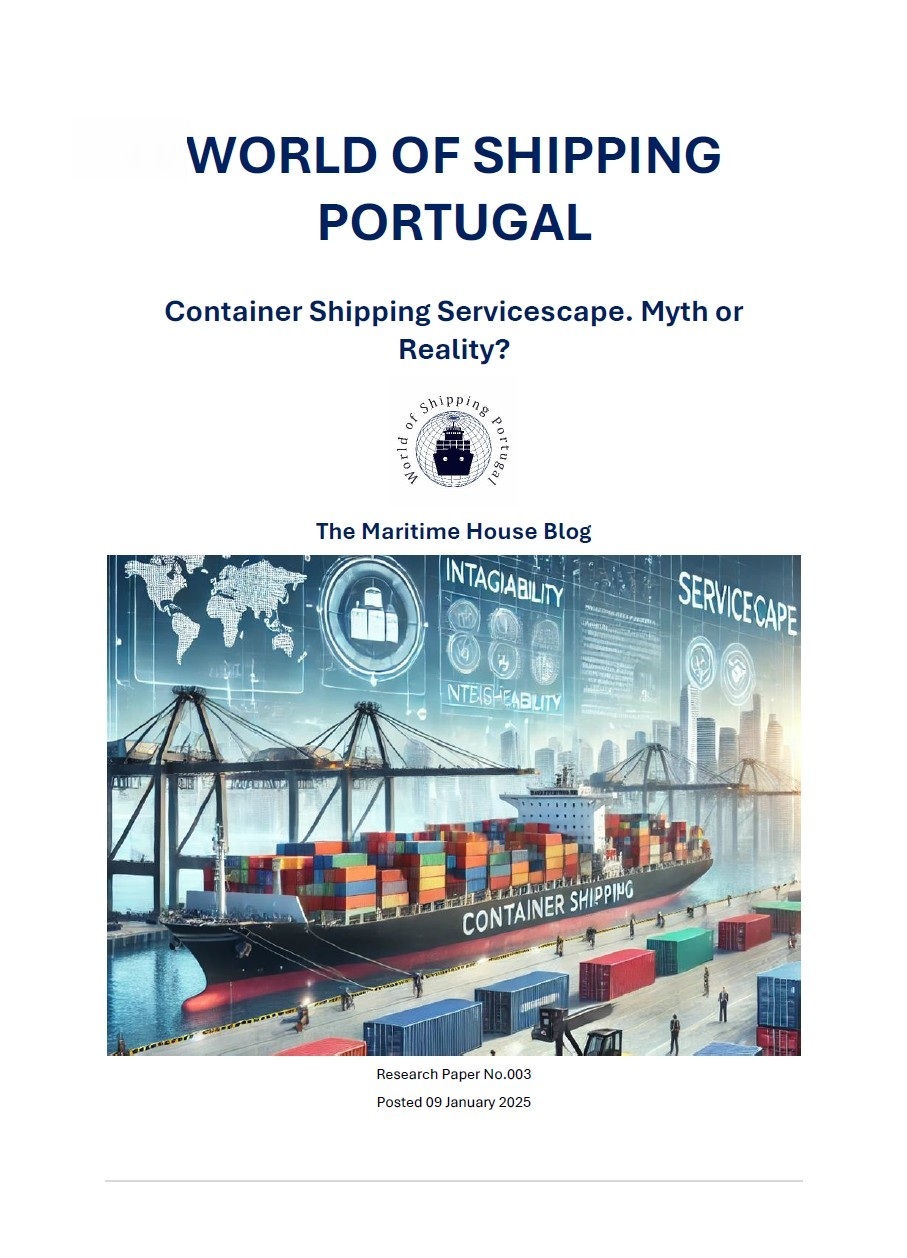
| 2025 - Container Shipping Servicescape. Myth or Reality?, by Ana Cristina Paixão Casaca. Published in the The Maritime House Blog. |
| 2023 - From Blue to Orange. What is the Answer?, by Ana Cristina Paixão Casaca. Published in the The Maritime House Blog. |
| 2022 - Maritime Education and Training during COVID-19 Pandemic: An Assessment, by Ana Cristina Paixão Casaca and Maria Amélia Ramos Loja. Published by Ana Cristina Paixão Casaca, Parede, Lisboa, Portugal. ISBN: 978-989-53925-0-6 |
| 2007 - Gestão da Cadeia de Abastecimento na Competitividade das Empresas e a Criação de Valor, (in English: Supply Chain Management in the Competitiveness of Business Enterprises and the Value of Chain), Cargo Edições. Published in the July/August 2007 Cargo Magazine. The work was sponsored by Administração dos Porto de Sines and Administração dos Portos do Douro e Leixões (Monograph). |
| 2006 - Co-written with Peter B. Marlow. The impact of the trans-European transport networks in the development of short sea shipping, Working Paper nº 17, Lisbon: Instituto Superior de Gestão (Working Paper). |
| |
|
| |
|
| Top of the page |
|
|